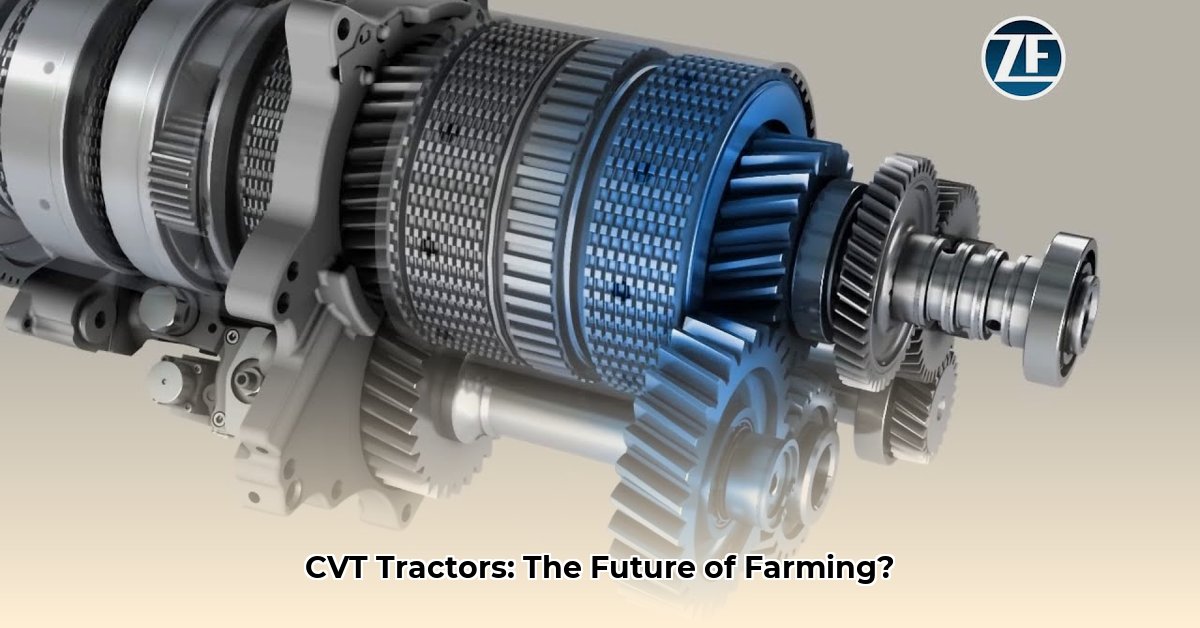
How CVT Transmissions Work: Smooth Power Delivery
Continuously Variable Transmissions (CVTs) are transforming modern agriculture, offering a smoother, more efficient alternative to traditional powershift transmissions. Unlike powershifts with fixed gears, a CVT adjusts its gear ratio infinitely, similar to an infinitely adjustable bicycle gear system. This is achieved using two pulleys connected by a belt; the pulleys change size, altering the speed ratio between the engine and the wheels. A sophisticated hydraulic system manages this adjustment, monitoring engine speed and workload to maintain near-optimal engine RPM. This results in seamless power delivery, reduced engine strain, quieter operation, and improved fuel economy. For more detailed tractor specifications, see Case 930 specs. Is this technological advancement worth the investment? Let's explore.
Powershift Transmissions Explained: Tried and True Efficiency
Powershift transmissions operate like advanced manual gearboxes with numerous gears, shifting rapidly via a sophisticated clutch system. This allows for quick changes in speed and power output, making them well-suited for tasks demanding sudden bursts of power. While not as seamless as CVTs, powershifts offer quicker acceleration from a standstill, a significant advantage in situations requiring rapid response. Do these advantages outweigh the benefits of a CVT? The answer, as we shall see, depends on several factors.
CVT vs. Powershift: A Detailed Comparison
Choosing between CVT and powershift depends on your specific needs. The following table highlights key differences:
| Feature | CVT Transmission | Powershift Transmission |
|---|---|---|
| Initial Cost | Higher | Lower |
| Fuel Efficiency | Significantly better | Good, but generally less efficient than CVT |
| Maintenance | More complex, potentially higher costs | Generally simpler and cheaper to maintain |
| Operational Ease | Very user-friendly, minimal operator skill needed | Requires more operator input and skill |
| Durability | Increasingly reliable, but a newer technology | Well-established, proven durable technology |
| Application | Versatile; excels in precision tasks (spraying) | Best for heavy-duty tasks (plowing, tillage) |
| Power Output | Consistent power delivery | Power delivery varies slightly between gear shifts |
Factors Influencing the Choice of Transmission
Several factors must be considered:
- Budget: CVTs have a higher upfront cost.
- Typical Tasks: The primary tasks (e.g., tillage, spraying, transport) heavily influence the choice. Precision work favors CVTs, while high-torque demands favor powershifts.
- Operator Skill: CVTs are more user-friendly; powershifts demand greater operator skill.
- Long-Term Cost: Consider fuel savings and potential maintenance costs. The higher initial cost of a CVT may be offset by lower fuel consumption over time.
Case Studies: Real-World Applications
Large-scale grain farmers often opt for CVTs to maximize fuel efficiency across extensive acreage. In contrast, smaller operations primarily focused on tillage might find a powershift more cost-effective due to its lower initial investment. This highlights the importance of tailoring the transmission choice to individual farming contexts.
Conclusion: Selecting the Best Transmission for Your Needs
The choice between CVT and powershift transmissions is not one-size-fits-all. Careful evaluation of budget, typical tasks, operator skill, and long-term cost of ownership is crucial. While CVTs are gaining popularity due to their superior fuel efficiency and ease of use, powershifts remain a robust and reliable option. The right choice depends entirely on the specific requirements of your farm operation.